The Kill The Diva Protocol: Why Brands Are Trading Egos for Algorithms
The notification hits your phone. It’s another apology video. Some 22-year-old with perfect teeth and a morality complex is crying in front of a ring light, explaining why they tweeted something offensive in 2014. Their brand deals are incinerating in real-time. The PR team is scrambling. The stock price dips.
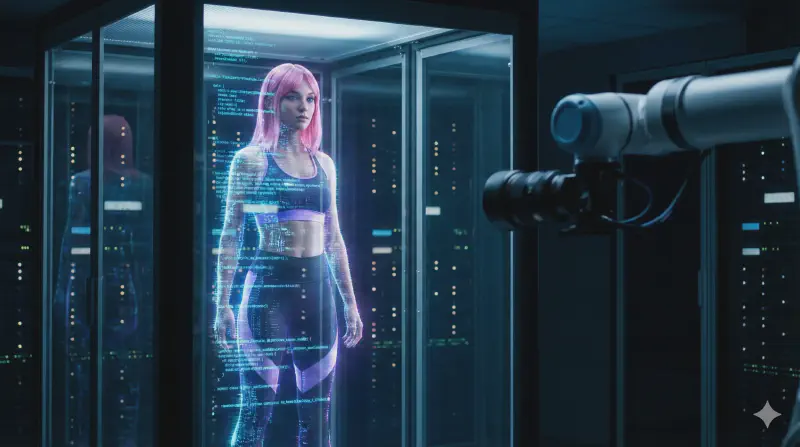
Somewhere in Barcelona, a server hums quietly. Aitana Lopez is posting a selfie. She looks flawless. She’s wearing the brand’s gear perfectly. She has never tweeted a slur. She doesn’t need a mental health break. She doesn’t have a drug problem. She doesn’t even have a body.
And she’s making €10,000 a month.
Welcome to the “Kill The Diva” Protocol. The Creator Economy is dead; we are watching the birth of the Control Economy. Brands are waking up to a brutal realization: Humans are a liability. Code is an asset.
Table of Contents
- The Unreliable Narrator: Why Humans Are Bad for Business
- Enter Aitana: The Pink-Haired Cash Cow
- The Economics of “Zero-Risk” Inventory
- The “Uncanny Valley” of ROI: Do They Actually Convert?
- The Mermaid Model: The Flywheel of Synthetic Fame
- The Psychology of the “Safe” Crush
- The Legal Wild West: Who Owns the Face?
- The Human Resistance: The “Authenticity” Premium
- Conclusion: The Final Render
The Unreliable Narrator: Why Humans Are Bad for Business
Let’s be real for a second. Working with human influencers is a nightmare. We’re talking about “talent” that demands five-star hotels, ghosts on deliverables, gets cancelled for dating the wrong person, and charges $50,000 for a TikTok that took fifteen minutes to film.
Rubén Cruz, the founder of The Clueless (the agency behind Aitana), didn’t build her because he loved sci-fi. He built her out of spite. He was tired of projects derailing because a model had an “ego” or simply didn’t show up.
He realized the fundamental bug in the system: Human Autonomy.
When you hire a human, you are renting a chaotic biological system. When you build an AI, you own the IP. You control the narrative, the aesthetic, the caption, and the comment section. There are no sick days in the server room.
Enter Aitana: The Pink-Haired Cash Cow
Aitana isn’t just a “virtual influencer.” She is a proof-of-concept for the replacement theory. She’s a 25-year-old, pink-haired fitness enthusiast from Barcelona who exists solely as pixels and engagement metrics.
She has 300,000+ followers. She gets DM’d by celebrities asking her out (which is hilarious and tragic). She does brand deals for supplements and sportswear.
Here is the kicker: The audience doesn’t care that she’s fake.
They know. It’s in her bio. But the dopamine hit is the same. The aspiration is the same. The “parasocial loop” closes just as tightly around a synthetic waist as a real one. The Clueless agency is pulling in decent revenue—up to €10k a month—with zero overhead for travel, makeup, or craft services.
The Economics of “Zero-Risk” Inventory
We call this “The Inventory Problem.” In traditional marketing, influencers are “unpredictable inventory.” You are buying attention futures, but the underlying asset is volatile.
AI Influencers represent Stable Inventory.
- Cost Efficiency: A recent breakdown suggests human influencers cost an average of $78,777 per post, while AI counterparts average $1,694. That is a 97% reduction in cost for visual assets.
- Brand Safety: An AI will never get drunk on a livestream. An AI will never have a controversial political opinion unless you program it to.
- Scalability: You want to enter the Brazilian market? Clone the model, translate the language, tweak the skin tone slightly (if you want to be cynical about localization), and launch.
Recent data suggests that over 69% of marketers have already integrated AI into their marketing operations. They aren’t just using it to write captions; they are using it to replace the talent.
The “Uncanny Valley” of ROI: Do They Actually Convert?
This is where the tech-bros usually get quiet. Sure, Aitana looks cool, but does she move product?
The data is currently a mixed bag, which is code for “Humanity isn’t dead yet.”
- Engagement: AI influencers often see higher engagement rates on visuals because of the novelty factor and the “perfect” aesthetic.
- Trust: This is the bottleneck. Studies by HypeAuditor show that while people watch AI, they trust humans about 2.7x more when it comes to actual recommendations.
If a human tells you a skin cream works, you believe them because they have skin. If an AI tells you a skin cream works, you are essentially listening to a cartoon character.
However, for lifestyle, fashion, and visual aesthetics, the trust barrier is lower. You don’t need to trust the model to like the shirt. You just need to see the shirt on a hot body. Does it matter if the body was rendered in Stable Diffusion?
The Mermaid Model: The Flywheel of Synthetic Fame
How does a nothing-burger of code become a revenue-generating star? It’s a closed loop of data and generation.
The difference here is the Feedback Loop (E). A human influencer can’t fundamentally change their face or personality overnight based on A/B testing. An AI can. If “Goth Aitana” tests better than “Gym Aitana,” the pivot happens in hours, not months.
The Psychology of the “Safe” Crush
Why are we okay with this? Why are men sending love letters to Aitana?
It’s the Disney Princess Effect. We are conditioned to love simplified, hyper-stylized representations of humanity. Real humans are messy. They have bad angles. They have bad days.
Virtual beings offer a “Safe Crush.” It is intimacy without vulnerability. It is a one-way mirror where the viewer can project all their desires onto a blank canvas that smiles back forever. Brands love this because “Safe” sells. It’s the same reason corporate mascots exist, but now the mascot looks like a supermodel and replies to your DMs.
The Legal Wild West: Who Owns the Face?
We are sprinting toward a legal cliff.
- Disclosure: The FTC and European regulators are scrambling. Do you have to tag #AI? Yes. Do people read it? No.
- Likeness Theft: We are already seeing “agencies” scraping the faces of real models to train their AIs. It is digital body snatching.
- Copyright: If an AI generates a post that goes viral, who owns it? The prompter? The platform? The algorithm?
Right now, it’s a gold rush. Get in, extract value, and apologize later.
The Human Resistance: The “Authenticity” Premium
Don’t short-sell humanity just yet. As the web floods with synthetic perfection, “Raw” is becoming the new luxury good.
We are predicting a bifurcation in the market:
- Tier 1: The Synthetics. Used for fast fashion, generic lifestyle, and volume content. High gloss, low trust.
- Tier 2: The Humans. Used for deep storytelling, vulnerability, and high-trust reviews. “Realness” will command a premium price.
The influencers who survive the purge won’t be the ones with the best filters. It will be the ones with the most interesting flaws.
Conclusion: The Final Render
The “Kill The Diva” protocol isn’t personal. It’s strictly business. It’s the industrialization of charisma. We mechanized weaving, we mechanized farming, and now we are mechanizing charm.
Aitana Lopez is not an anomaly; she is the prototype. She never sleeps, she never ages, and she never asks for a raise. In the boardroom of the future, that’s the employee of the month, every month.
So, go ahead. Post your apology video. The render farm is already spinning up your replacement.
Sources
- The Clueless Agency - The creators of Aitana Lopez
- The Data Scientist - AI Influencers Marketing Investment 2025 - Cost vs. risk analysis of Virtual vs. Human influencers ($78k vs $1.6k)
- HypeAuditor - AI Influencers vs Human Influencers - Comparative studies on engagement rates and the “Trust Gap”
- Influencer Marketing Hub - AI Marketing Benchmark Report - 2025 AI Marketing Benchmark Report regarding the 69% adoption rate